



Product and specifications
What is the Brunstock 5 MWh BESS?
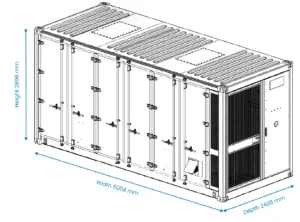 The Brunstock 5 MWh BESS is a front-of-meter DC battery energy storage system housed in an enclosure the same size as a standard 20-foot container. Each DC block delivers 5 MWh of usable energy and is designed for utility-scale and grid-connected applications.
What are the key physical specifications?
- Energy capacity: 5 MWh per DC block
- Container format: 20-foot
- Dimensions: 6058 × 2438 × 2896 mm (W × D × H)
- Weight: approximately 41–43 tonnes
- Ingress protection: IP55
- DC voltage output: approximately 1400–1500 V
- Frequency: 50/60 Hz
What cell chemistry and format are used?
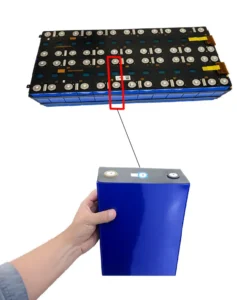 The system uses lithium iron phosphate (LFP) cells, 314 Ah format, liquid-cooled. LFP offers excellent thermal stability and a long cycle life, making it well-suited to front-of-meter applications with daily cycling. Read more about Brunstock battery cells used in the BRUN-BESS-5MWh.
What C-rate does the system support?
The Brunstock 5 MWh block is a 0.5C product. This is the most widely used C-rate in utility-scale storage and provides the best balance of cycle life, thermal stability, and total cost of ownership. We do not offer 1C or 2C variants. For applications requiring higher apparent power output, we recommend appropriately sizing the system—for example, a 50 MW system using 0.5C blocks to deliver 25 MW continuously.
How scalable is the system?
The DC block is the modular building block. Multiple blocks are combined with a Brunstock step-up station for BESS, which is an AC skid (inverter/PCS, transformer, and switchgear) to build systems of any size. Projects to date have ranged from single-block 5 MWh installations to multi-block systems of 15 MWh and above.
Construction and durability
What makes the Brunstock container more durable than a standard import?
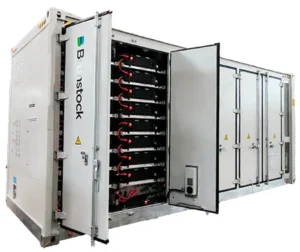 Two features stand out. First, the base frame is fully hot-dip galvanised—corrosion in container-format equipment typically starts at the base from contact with transport surfaces and ground moisture, and a galvanised frame addresses this directly. Second, the standard paint specification is marine-grade C5, applied to factory-documented thickness. C5 is suitable for the vast majority of industrial, inland, and moderate coastal environments. For highly corrosive or specialist environments (offshore-adjacent, chemical, mining), a C6 upgrade is available on request. All paint thickness measurements are included in the factory technical report delivered with each unit.
What temperature and altitude conditions can the system operate in?
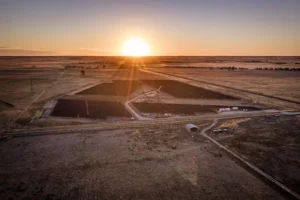
Standard operating temperature range is up to approximately 45 °C ambient. Intermittent exceedances above 45 °C can be accommodated; sites with sustained ambient temperatures consistently above this threshold should be flagged at the scoping stage so that derating requirements can be calculated. High-altitude sites are also supported—the system has been scoped for sites above 2000 m—with derating applied as appropriate. GPS coordinates are required at the project scoping stage to determine altitude accurately.
Cooling system
How does the cooling system work?
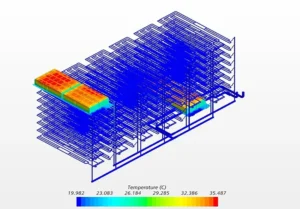 The system uses a liquid cooling circuit—50% water, 50% glycol—approximately 300 litres total. A radiator core at the base of each battery pack distributes coolant evenly beneath the cells, cooling from the bottom up. Coolant flows through quick-release push-fit pipe connections between packs, each with an integrated valve that prevents spillage when disconnected. Read more about the fire suppression system on the auxiliary system page for our 5 MWh BESS.
Where are the fans located and how loud is the system?
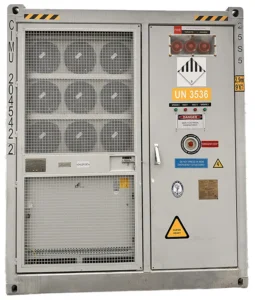 Cooling fans are side-mounted and form part of the HVAC system that drives the liquid cooling circuit. Standard measured noise output is approximately 70 dB. For installations close to noise-sensitive areas, an optional noise suppression hood can be fitted to the front fan assembly to reduce sound output. Note that this option slightly restricts airflow and is recommended only where noise constraints make it necessary.
Battery management and safety
What BMS architecture does the system use?
The BMS is a three-level topology:
- BMU (battery management unit)—inside each battery pack, monitoring at pack level
- Cluster manager—aggregates data across packs within a rack
- BAMS (battery management system)—top-level system controller managing all racks and packs
Every individual cell is temperature-monitored. Each rack has its own DC isolator, allowing individual racks to be isolated for maintenance without taking the whole system offline.
What happens if a battery pack fuse blows?
Each pack has a dedicated fuse. If a fuse operates, the HMI will indicate that the pack is disconnected and available energy capacity will reduce accordingly. The pack can be replaced without affecting surrounding packs. Replacement is at the pack level—individual cells are not field-serviceable, as packs are robotically sealed during manufacture.
What fire suppression is fitted as standard?
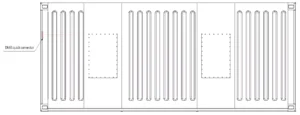 Every container is supplied with an automatic aerosol fire suppression system. Fire detectors inside the container monitor continuously; if triggered, the system releases a blanket suppression agent from canisters mounted to the interior roof, covering the full container volume. The system is integrated into the building management and fire alarm panel at the rear of the container and connects to the customer’s SCADA system so health and activation status are visible remotely.
An independent fire safety inspection of the fire alarm system is recommended annually, in the same way as a commercial building fire alarm—Brunstock installs a building management and fire interface that complies with local market requirements.
A large emergency stop button is also fitted to the exterior of the container, along with audible and visual alarms, providing on-site personnel with an immediate manual shutdown option.
Read more about the fire suppression system on the auxiliary system page for our 5 MWh BESS.
What testing has been done on fire and thermal runaway behaviour?
The 5 MWh container has undergone UL flammability testing, including destructive burn testing to validate that thermal runaway is contained and does not propagate between cells or racks beyond the container boundary. Cell-level testing includes electrical short-circuit and mechanical puncture tests per UL standards. Full test documentation—including degradation curves, FEA reports, paint thickness records and burn test results—is available to customers at the tendering stage.
What explosion protection features are included?
Each battery pack is fitted with an explosion-proof vent. In a worst-case thermal event, the vent opens to release gas safely, reducing pressure build-up inside the pack.
System integration
Does Brunstock supply its own inverter or PCS?
No—by design. The step-up station (AC skid) is technology-agnostic and can accept any inverter or power conversion system (PCS) the customer specifies or has already procured. We do not have a proprietary PCS and we do not lock customers into one. Customers may free-issue their preferred PCS brand for integration into the skid, or we can recommend and supply appropriate options for the project.
Is there any hardware or software lock-in?
No. Our platform is explicitly open. The DC block, AC skid, power plant controller and EMS can each be sourced independently or in combination. Customers with preferred suppliers for any component are welcome to use them. This flexibility is particularly valued by customers with strong in-house engineering teams who want to specify their own technology stack.
What EMS options are available?
Brunstock offers an EMS solution as part of its integrated offering. Third-party EMS platforms can also be integrated—the system is designed to work with any standard EMS via open protocols.
Can the system support grid-forming operation?
Yes. The system supports both grid-following and grid-forming configurations. Grid-forming allows the BESS to independently nominate grid frequency (50 or 60 Hz) and support black-start capability. The required configuration is confirmed at the scoping stage.
What applications is the system suited to?
- Energy arbitrage
- Frequency control ancillary services (spinning reserve)
- Capacity firming for renewable generation
- Renewable energy integration and smoothing
- Transmission and distribution deferral
- Microgrid and off-grid support
- Black start (grid-forming configuration)
Certifications and compliance
What certifications does the Brunstock 5 MWh BESS hold?
- IEC compliant (suitable for IEC-standard grid markets including Africa, Europe and Australia)
- UL flammability tested; certificate issued
- TUV technical bankability report available at the tendering stage
- Brunstock is a Clean Energy Council (CEC) member in Australia
Is the system IEC or UL—which standard applies to my market?
The DC block is IEC-compliant as standard. For markets using IEC grid codes (including South Africa and most of Africa), no modification to the DC block is required. UL flammability testing is in addition to IEC compliance and provides an additional layer of credibility for customers requiring US-aligned safety standards.
See the certifications listed inside the table on our 5 MWh BESS page.
What documentation is provided with each unit?
Each delivery is accompanied by a factory technical report including cell degradation curves, FEA thermal analysis, paint thickness measurements (C5), and test reports for noise and compliance. Additional documentation (burn test results, UL certificate) is available on request.
Brunstock also maintains a product brochure, user manuals, technical specifications and other documentation.
Monitoring, O&M and long-term service
Does Brunstock offer ongoing monitoring and O&M support?
Yes. Brunstock is or will operate a cloud-based O&M monitoring platform that provides 24/7 visibility of each deployed system under an LTSA with us. The platform supports:
- Portfolio view across multiple sites
- DC block and PCS skid status
- Cell and rack performance tracking
- Degradation monitoring against guaranteed curves
- Alert and event management with nominated escalation contacts
- Auxiliary equipment and fire and safety system status
The platform uses regionally hosted cloud infrastructure and delivers alerts to nominated service contacts, with escalation logic for after-hours events.
Fall-back information is available on our service page.
What does a long-term service agreement (LTSA) include?
LTSAs are available from one to 15 years (with 10–15 years being most common). Standard LTSA scope includes:
- Preventative maintenance to a documented 32-point checklist
- 24/7 remote monitoring via the Brunstock cloud platform (OEM view-only access)
- In-country spare parts holding with supplier replenishment during the warranty period
- Warranty backed to the factory
- Connection to a recommended local battery recycling partner
LTSA pricing is modelled on a fixed lifecycle cost basis. Modelling consistently shows that a fixed LTSA is less expensive than pay-as-you-go ad hoc support over a 10-year horizon, primarily because planned maintenance and in-country spares eliminate the high costs of unplanned callouts.
Is cell degradation guaranteed?
Yes. Brunstock guarantees the degradation curve of the cells year-on-year from commissioning. The guaranteed capacity at each anniversary of commissioning is documented in the LTSA and cannot be exceeded. The monitoring platform tracks actual degradation continuously to support warranty compliance.
What commissioning and training is provided?
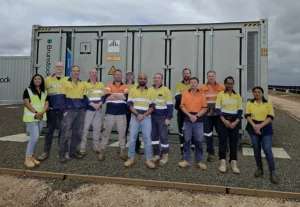 Commissioning is conducted by or with the customer’s team on site, depending on the contract between them and their Brunstock representative. HMI training is delivered hands-on during the commissioning process or as per the written agreement. Local assembly, pre-commissioning, and factory acceptance testing (FAT) can be performed prior to dispatch, with the customer invited to attend.
How are critical spares managed?
We recommend customers hold a set of critical spares on site with each BESS installation. During the warranty period, any spare consumed on site is replenished by Brunstock. This approach reduces downtime to near-zero for most fault scenarios—the spare is available immediately rather than waiting for logistics.
Project scoping
What information does Brunstock need to size and quote a project?
To prepare an accurate proposal we typically need:
- Site GPS coordinates (for altitude and location-based derating)
- Site type: greenfield, brownfield, rooftop, indoor or outdoor
- Ambient temperature range and corrosion environment (coastal, industrial, etc.)
- Required usable energy at beginning of life (BOL) and end of life (EOL)
- AC power at point of connection
- Cycles per day (default: one cycle per day)
- Primary application (arbitrage, frequency response, firming, etc.)
- Grid connection type: transmission, distribution, behind-the-meter, microgrid or off-grid
- Grid-forming or grid-following requirement
- PCS preference (customer-supplied, or Brunstock to recommend)
- EMS: in scope or out of scope
- LTSA: required, and for how many years
- Project stage: feasibility, concept design or procurement-ready
- Grid connection agreement status (if applicable)
The most efficient way to work through these is a short scoping conversation—contact us to get started.
How long does a typical project take from first contact to commissioning?
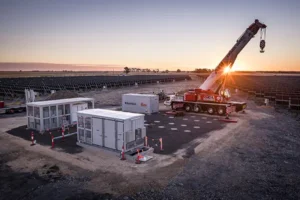
This varies significantly by market and project complexity. A key milestone is the grid connection agreement—in markets where this process is required, it typically takes around eight months. Projects that have already secured their connection agreement and completed concept engineering are generally 3–6 months from order to commissioning for a standard multi-block system.
Disclaimer: Images shown are for marketing purposes only. Some are computer-generated illustrations or modified photos of particular projects. Exact colours, finishes, and configurations of delivered equipment may vary from those depicted. All specifications, dimensions, and performance figures are indicative, subject to change without notice, and should be confirmed with your local Brunstock representative before being relied upon. While care has been taken in preparing this material, Brunstock accepts no liability for errors or omissions, to the extent permitted by law. This page does not constitute an offer, quotation or contractual commitment.

Service regions
Brunstock supplies substation solutions and energy storage equipment to approved markets including Africa, Australia and Europe through its representatives in Australia, Germany, South Africa and Switzerland.
Our centralised manufacturing combined with local expertise ensures that our engineering solutions are deployed with outstanding customer service, compliance to regional standards and the benefits of economy-of-scale.

